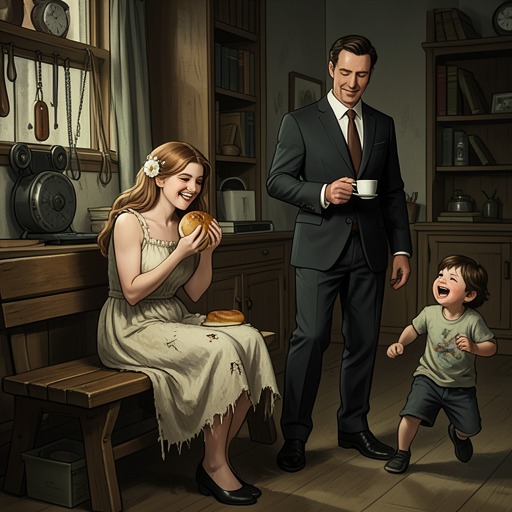
Tao Sister
I’m Very Happy After Marrying the CEO Husband According to the AgreementTao Sister is the household caregiver who most consistently translates Shen Tang’s new wealth and contractual marriage into lived experience. She is not merely a servant who prepares meals: through desserts, nourishing food, sandwiches, soup, reminders, and concern over Shen Tang’s condition, she becomes one of the first people to offer Shen Tang the ordinary care of a family. Her presence gives emotional substance to a household arrangement that initially exists on paper, while also exposing the practical labor required to sustain its appearance.
Identity and Household Role
Tao Sister belongs to the domestic world surrounding Shen Tang and Gu Huaian, working alongside Uncle He in the residence. Her responsibilities include preparing food, bringing it directly to Shen Tang, monitoring her health, and responding to the household’s changing circumstances. When Shen Tang returns after being away for a night, Tao Sister is in the living room with Uncle He, and she immediately hurries over to help Shen Tang sit down before offering her soup. The response is instinctive and protective rather than formal, establishing Tao Sister as someone who notices Shen Tang’s condition and treats her as a person requiring care.
Her role also includes maintaining the household’s social choreography. Shen Tang’s marriage agreement requires her to appear occasionally at family dinners and preserve the image of a loving couple, and Tao Sister’s domestic work supports that arrangement from behind the scenes. She prepares food for both spouses, sends provisions to Gu Huaian’s workplace, and helps make the marriage look continuous even when the couple is physically separated. In this sense, she operates in the household’s backstage: the affection displayed publicly depends partly on the meals and gestures she organizes privately.
Care Through Food and Routine
Tao Sister’s most distinctive form of affection is culinary. After Shen Tang eats a lavish meal, Tao Sister brings dessert and fruit to the sofa while Shen Tang lies back to digest. The air-flown fruit, contrasted with the discounted food Shen Tang had bought in her previous life, makes the household’s wealth tangible, but Tao Sister is the person who turns that wealth into a repeated experience of comfort. Shen Tang’s astonishment at such abundance is therefore mediated through Tao Sister’s routine service rather than through abstract financial status.
When Shen Tang tries to diet, Tao Sister does not simply leave her without food. She prepares a salad specifically for her while reserving the rest of the sumptuous dinner for Gu Huaian, who is expected home that night. The exchange shows Tao Sister balancing individual care with household expectations. She respects Shen Tang’s stated wish to avoid the main meal, yet still makes certain that the wife has something prepared and accessible.
Her attention becomes playful as well as practical. She brings Shen Tang nourishing milk tea containing cordyceps, and Shen Tang responds with enthusiastic gratitude and a flying kiss. The moment gives their relationship a light, affectionate register: Tao Sister’s health-conscious preparation is not presented as cold supervision, but as a familiar gesture that Shen Tang welcomes. Even the nickname-like domestic atmosphere surrounding their exchanges helps Shen Tang experience the residence as more than the expensive setting of a transaction.
Supporting the Contractual Marriage
Tao Sister also helps sustain Shen Tang’s relationship with Gu Huaian through small, carefully timed acts. After Shen Tang remarks that tycoons are prone to stomach problems, Tao Sister prepares sandwiches at Shen Tang’s request and has them delivered to Gu Huaian’s company. The sandwiches originate in a jokingly charged household situation, but they become an instrument of reconciliation and impression management: Shen Tang recognizes that Gu Huaian is the financial provider under the agreement and that she needs to make a favorable impression after making a mistake.
Tao Sister notices the irregularity in Shen Tang’s plan. When Shen Tang says that she may remain away from home because living there wastes commuting time and that absence may increase affection, Tao Sister asks whether she should continue making the sandwiches. Her question shows that she is attentive not only to food but also to the couple’s routine. Shen Tang tells her to continue and to have the driver deliver them, converting a potentially awkward absence into a visible sign of domestic consideration.
The sandwich episode captures Tao Sister’s position between emotional intimacy and contractual duty. She does not determine whether the marriage is genuine, but her labor helps preserve its appearance and creates opportunities for care to circulate between the spouses. The agreement promises Shen Tang a monthly payment of five million, living expenses charged to her husband’s card, and a two-hundred-million settlement after two years; Tao Sister’s work gives that financial arrangement a household texture that money alone cannot provide.
Medical Concern and Emotional Belonging
Tao Sister’s care carries particular weight because Shen Tang has previously lived in poverty and has invested her savings in children from the orphanage. One such child, an eight-year-old boy who is not Shen Tang’s biological brother, contracts leukemia, leaving Shen Tang nearly penniless before the marriage arrangement provides new resources. Against that background, Tao Sister’s food and concern represent a reversal of Shen Tang’s usual position. Shen Tang has been the one trying to support vulnerable children; in the Gu household, someone is now looking after her.
Shen Tang is deeply moved when Tao Sister and Uncle He worry about her after only one night away. She recognizes the feeling as a first experience of family, recalling that she had always been alone in her previous life. Tao Sister’s significance therefore exceeds her job description: her actions help establish a substitute family formed through daily care rather than blood. The household’s emotional legitimacy is built through repetition—someone prepares food, notices absence, brings soup, and asks whether the sandwiches should continue.
The care is not entirely solemn. Tao Sister serves Shen Tang a soup that tastes strange, and when Shen Tang asks what it is, Tao Sister reveals that it is kidney-nourishing soup. The comic directness of the remedy reinforces the intimacy of their relationship. Tao Sister is willing to embarrass or tease Shen Tang while still caring for her, and Shen Tang accepts the intervention with surprise rather than resentment. Their bond is thus expressed through a mixture of service, humor, and bodily concern.
Relationship to Shen Tang and Narrative Function
Tao Sister’s relationship with Shen Tang develops from household service into a warm caregiver-and-family bond. She helps Shen Tang sit down, prepares meals suited to her changing wishes, supplies expensive ingredients and medicinal additions, and remains alert to the couple’s movements. Shen Tang responds with affection, gratitude, and increasing comfort, treating Tao Sister as someone whose presence makes the residence feel safe.
Narratively, Tao Sister anchors the transformation from a purely transactional household to an emotionally inhabited one. The marriage agreement initially defines Shen Tang’s obligations as appearances at family dinners and the maintenance of a loving image, but Tao Sister’s work supplies the mundane acts through which intimacy is usually recognized. She makes the performance possible, yet her concern also begins to exceed performance. Her soup, fruit, salad, and sandwiches belong to the practical world of household management, while Shen Tang’s realization that she has found a family gives those acts their deeper meaning.
Tao Sister also represents the often-unseen labor behind social identity. Shen Tang is simultaneously a wealthy contractual wife, a scandal-ridden Z-list celebrity, and a woman carrying responsibility for an orphanage child with leukemia. Tao Sister’s domestic attention allows these conflicting identities to coexist: she feeds the celebrity, supports the wife, monitors the vulnerable woman, and quietly helps the household continue functioning when public reputation and private life threaten to diverge. By the time Shen Tang’s place among the Gu family is publicly acknowledged, with Old Madam Gu and Old Master Gu’s attitude shaping how other relatives receive her, Tao Sister has already helped establish that belonging at the intimate level of daily life.
Tao Sister’s later significance remains tied to this family framework. Questions about Shen Tang and Gu Huaian’s future wedding reveal that the couple’s relationship has moved beyond the original contract, but Tao Sister’s earlier care helps explain how such a change becomes imaginable. She is the domestic witness to a marriage that begins as an agreement and gradually acquires the routines, concern, and emotional compensation of a real household.